Consistent revenue visibility and accountability across your portfolio.
Every portfolio company on the same 16 KPI definitions. A ranked view of where revenue is at risk this week. Each material risk with an owner and a due date, and a quarterly review of what was done and what changed.
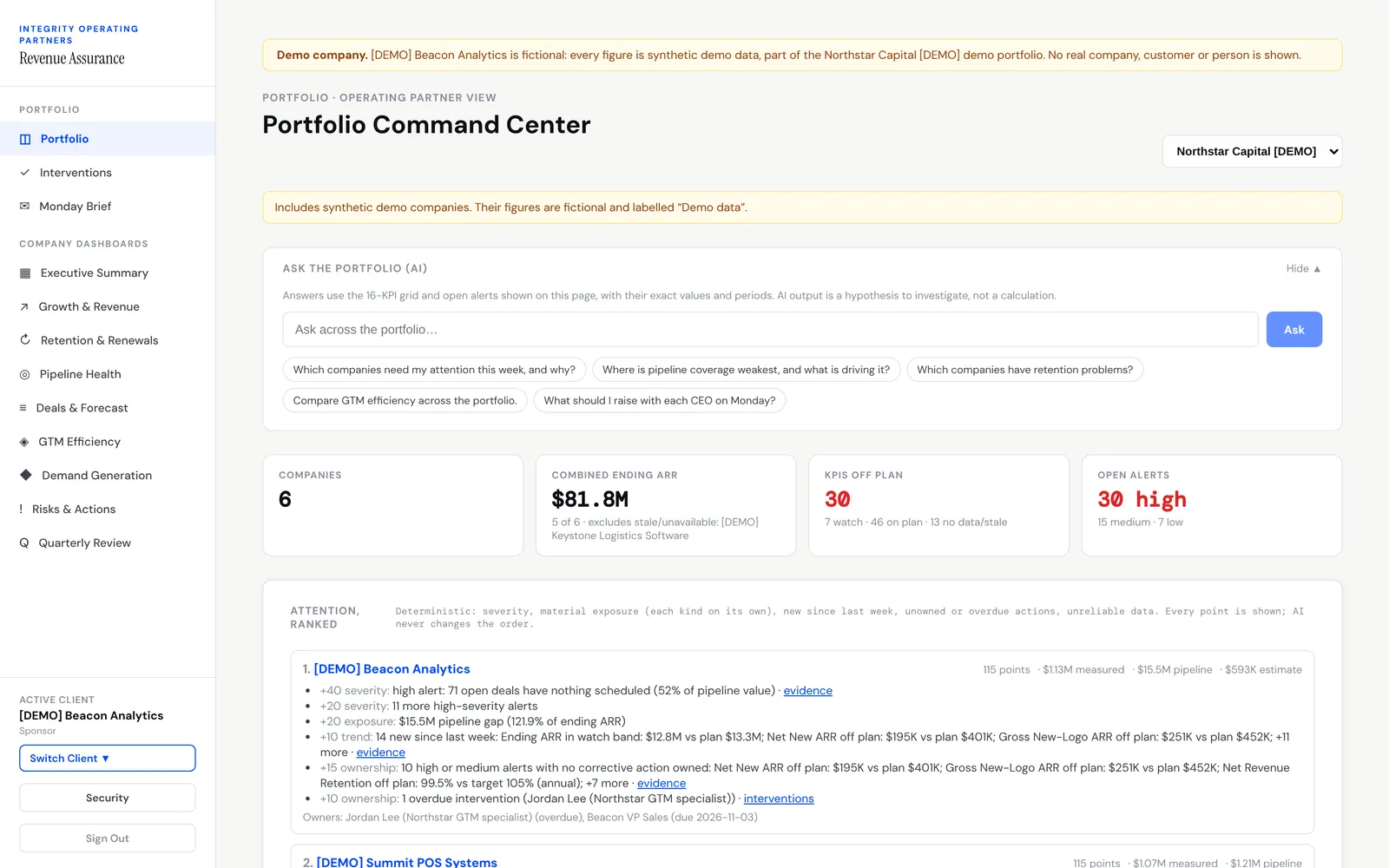
Each company reports revenue its own way. The sponsor finds out late.
Coverage, retention and payback are defined differently in every board pack. The data arrives at different times and quality. A risk raised in the operating review rarely has an owner and a date, and the next review starts from scratch.
One set of definitions
The same 16 KPIs, formulas, periods and target bases for every company, so a red cell means the same thing in every row.
A ranked attention view
Not a wall of dashboards: the companies that need attention, in order, with the evidence and exposure behind each position.
Owned actions, reviewed quarterly
Every material risk becomes an intervention with an owner, a target on the KPI and a due date, reviewed in the Quarterly Value Creation Review.
Three views of the same numbers.
The partner, the CEO and the VP Sales look at the same calculation; each sees the part that is theirs. Access is enforced in the database, and PE firm users sign in with an authenticator app.
The operating partner
Every portfolio company on one scorecard, a ranked list of where to look first, open risks with their evidence, the actions under way and who owns them, a Monday brief and a quarterly review per company or across the portfolio. Only their own firm's companies.
The CEO, CRO or CFO
The company's own 16 KPIs and the dashboards behind them, its risks and actions, the board report, Finance Review and certification, and a weekly digest. Only their own company.
VP Sales, Marketing or Customer Success
Only the KPIs, pages, alerts and actions of their area. A VP Sales sees pipeline, forecast, win rate and seller productivity, not the retention or finance detail.
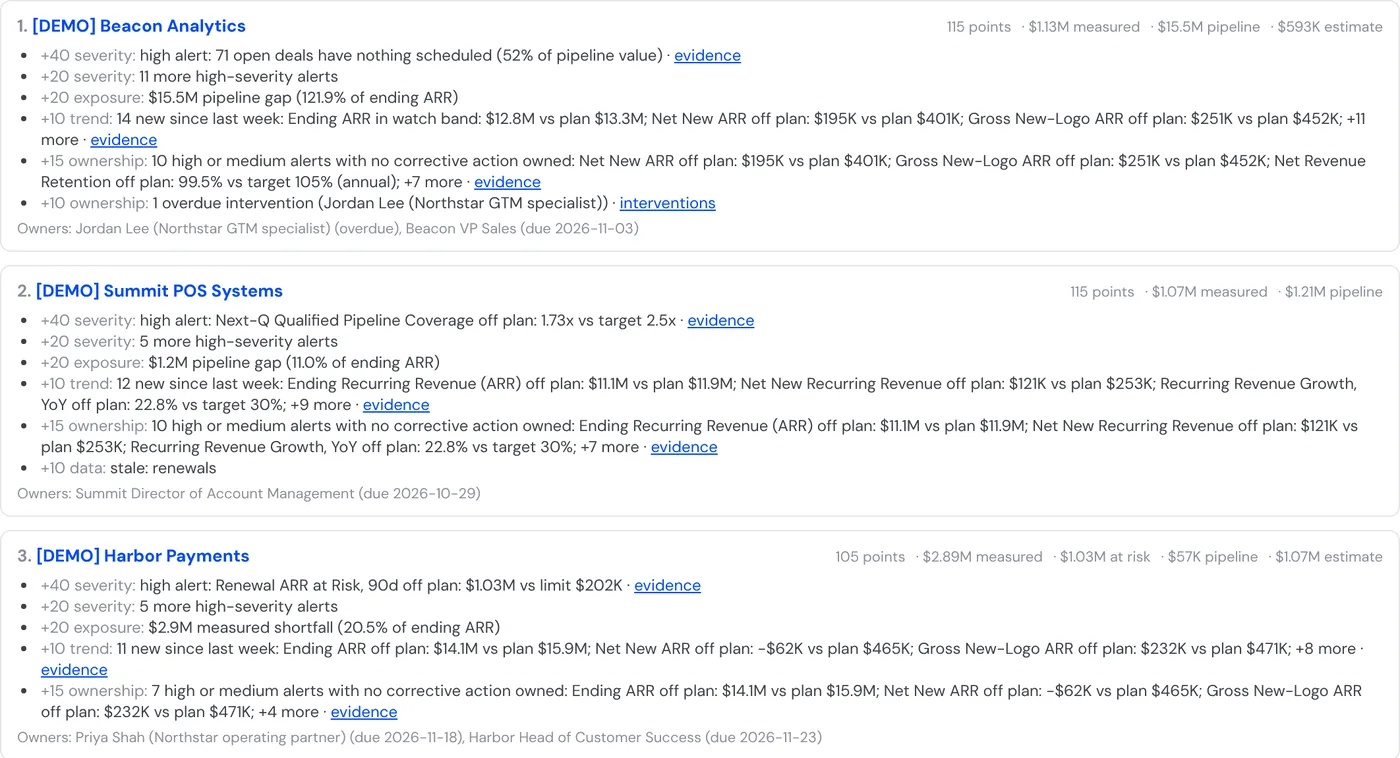
Where to spend Monday, with the reasons written down.
The ranking adds points for the most severe open alert, exposure that is material relative to the company's ARR, anything new since last week, risks nobody owns, overdue actions and unreliable data. Each point is listed, with a link to the evidence.
Next to it: companies improving, and companies whose data cannot be relied on yet. Unreliable data is a finding in its own right, not a reason to show green.
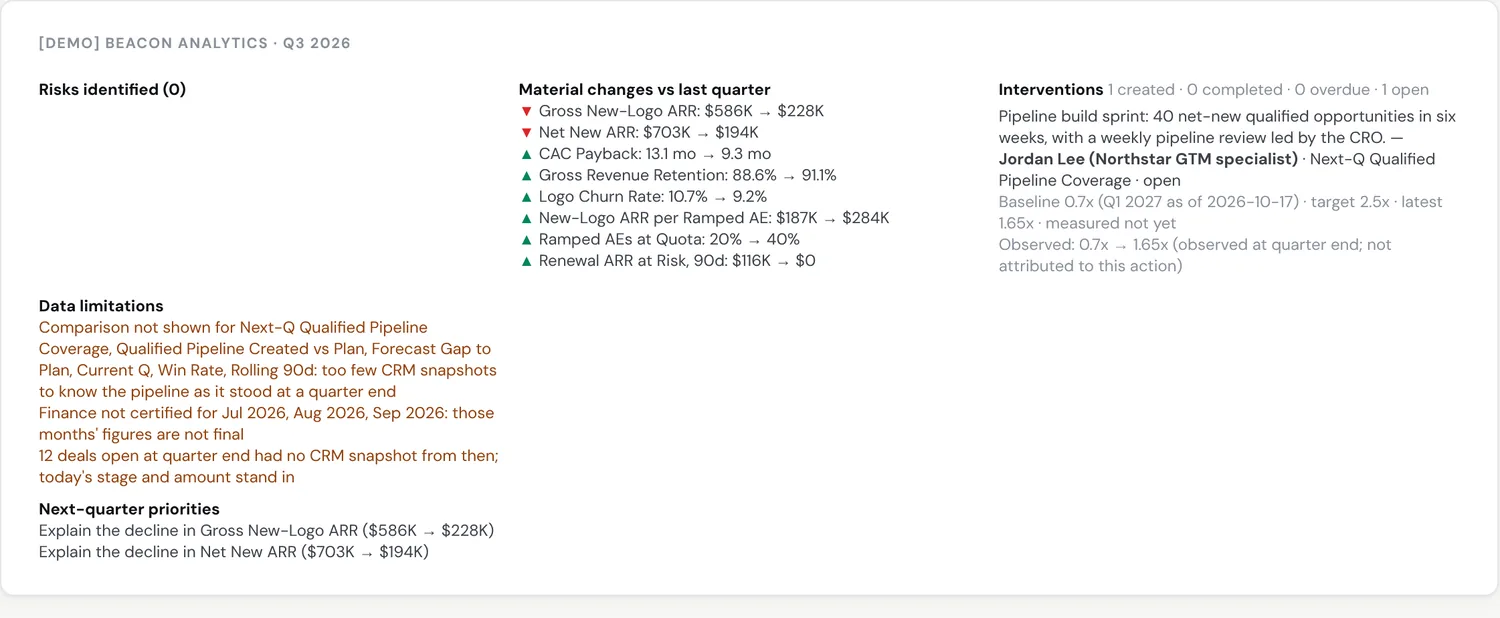
The Quarterly Value Creation Review.
Each quarter, per company or across the portfolio: the risks identified, the material KPI changes, and every intervention created, completed, overdue or open, with its owner, baseline, target and measured result, plus next-quarter priorities.
It is rebuilt from the history captured at quarter end and lists its own limitations, including anything it had to estimate. Changes are shown as observed, never credited to an action, which keeps the conversation with the board on solid ground.
A 30-day pilot with one to three portfolio companies.
On your own companies' data, under the security controls described below, with criteria agreed at kick-off. The pilot measures visibility and accountability; it is too short to show financial outcomes, and we will not claim it does.
Agree
Pilot companies, users, data-handling terms and success criteria.
Connect
Kick-off per company; the CRM connected and its first sync checked against the CRM's own reports.
Load
13+ months of P&L, the ARR bridge, the operating plan and targets. Scorecards go live.
Reconcile and operate
Finance Review and certification; weekly alerts and Monday brief; interventions on the risks you judge material.
Review
Results against the criteria, a quarterly review to date, and a decision: continue, extend or stop. Your data exported or deleted as you choose.
What each company supplies is listed in a one-page data request: CRM access, the monthly P&L, the plan and targets, and optionally customer ARR history, renewals and the sales roster.
What your technical team will ask.
A technical diligence summary covers architecture, isolation, access control, data handling, AI use and testing, with the current state stated plainly.
- Database-enforced isolation: a firm sees only its own companies; company users only their own.
- Authenticator-app sign-in for sponsor users and administrators.
- Append-only audit log; full export and permanent deletion of a company.
- Synthetic demo data kept apart from real data by the database.
- No customer deployments yet, no SOC 2 or other certification, and no third-party security audit.
Start with one to three companies.
Tell us about the portfolio and what you want to see earlier. We will propose a pilot scope, or show you the demo first.