From revenue data to owned, measured action.
The same six steps for every company, every week. Setup takes days, not a reporting project, and the routine afterwards is a monthly P&L upload and a weekly look at what changed.
Revenue data
CRM, the monthly P&L, the approved plan and targets.
Consistent metrics
16 KPIs from one engine, each with its source and freshness.
Early warnings
Rules that flag drift, with the evidence and the exposure.
Prioritized risks
A ranked list of where to look first, and why.
Corrective actions
An owner, a target and a due date for each risk that matters.
Measured outcomes
Progress tracked on the same KPI, reviewed each quarter.
Connect what the company already has.
The company's CRM administrator connects Salesforce, HubSpot, Pipedrive or Zoho in a few clicks. Finance uploads the monthly P&L exported from its accounting system and maps the lines once. The approved operating plan and KPI targets load through templates that are checked before anything is saved.
Optional data unlocks more: customer-level ARR history for cohort retention, renewals for renewal risk, the sales roster and quotas for seller productivity.
16 KPIs, one engine, every source labelled.
Each KPI is calculated once, against the approved plan, and shown with its period, basis, target, status, data quality and source freshness. Finance figures outrank the CRM, and Finance Review reconciles the two before finance certifies the month.
Rules, not guesswork.
Each week, deterministic rules check every KPI against its target, every open deal and renewal, recent trends and data freshness. An alert carries its evidence and a labelled exposure, and it stays open until the condition has actually cleared.
A ranked list with the reasons attached.
Across a portfolio, the attention view orders companies by severity, material exposure, what is new, what nobody owns, what is overdue and whether the data can be trusted, and lists the points behind each position.
An owner, a target and a date.
A risk the operating partner or leadership judges material becomes an intervention: the finding, a hypothesis, the action, its owner, a target on the KPI and a due date. The baseline is captured automatically.
Progress on the same number, reviewed each quarter.
The result is recorded at the due date and appears in the Monday brief and the Quarterly Value Creation Review, reported as an observed change, not as proof the action caused it.
Little to maintain, a lot to act on.
CRM refresh
Every connected CRM is synced, with retries; failures are flagged to the administrator, never shown as success.
Alerts and brief
Early-warning rules run on Mondays; sponsors get the Monday brief and company leaders a digest of their own KPIs.
Close and certify
Finance uploads the P&L after close, explains any differences in Finance Review and certifies the month.
Value creation review
Risks, KPI changes and interventions for the quarter, per company or across the portfolio, with a PDF.
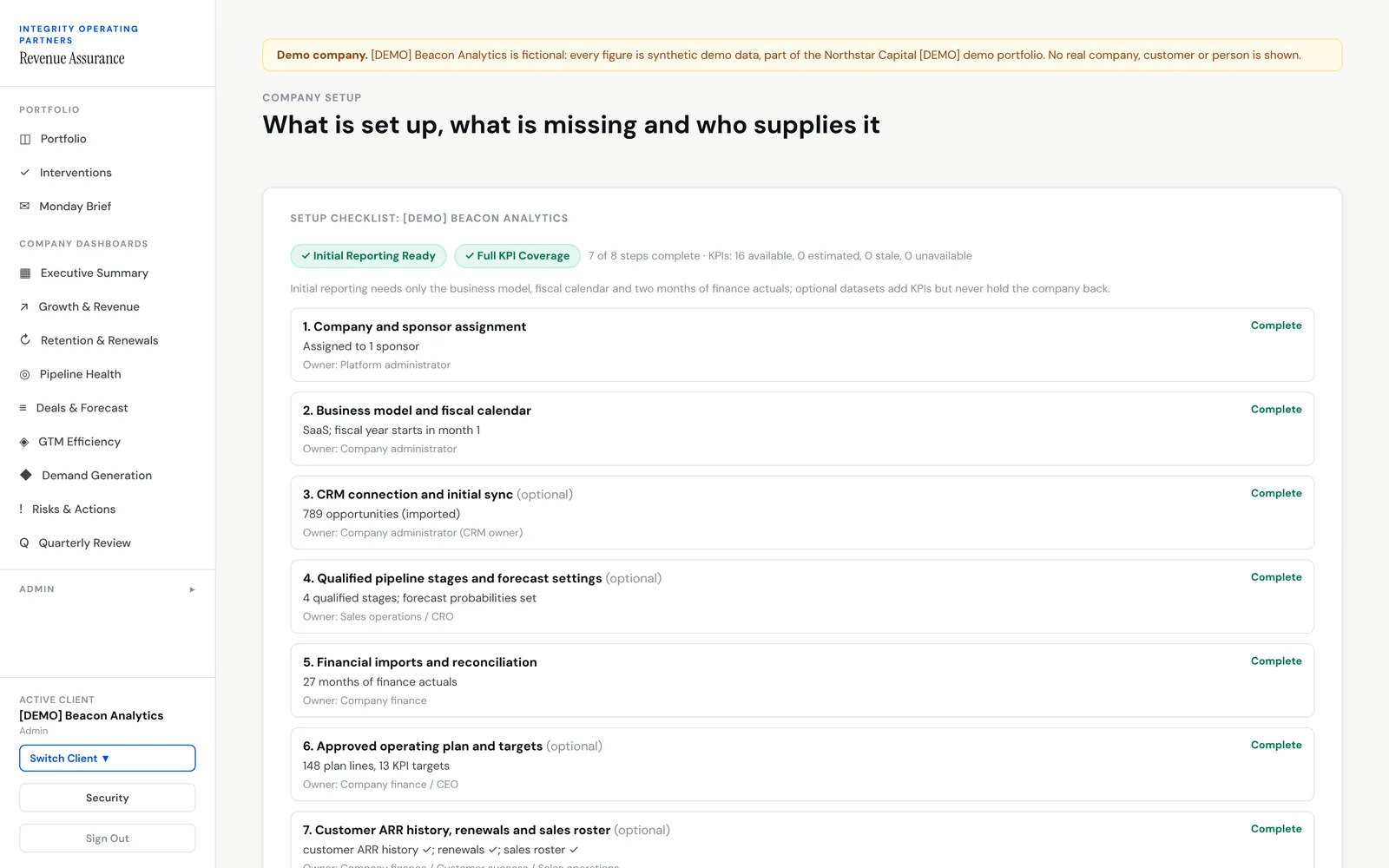
A guided setup, then reporting.
A setup checklist tracks each company to Initial Reporting Ready: business model and fiscal calendar, the CRM, two months of finance actuals, the plan and targets. Each step names who resolves it. Optional datasets add KPIs later without holding up the start.
For a sponsor, we suggest a 30-day pilot with one to three companies. Hands-on operating support is available if a company wants help with the data or the cadence; it is not required.
See the process on the demo portfolio.
A walkthrough on fictional data: the portfolio view, one company's numbers, an intervention and the quarterly review.